
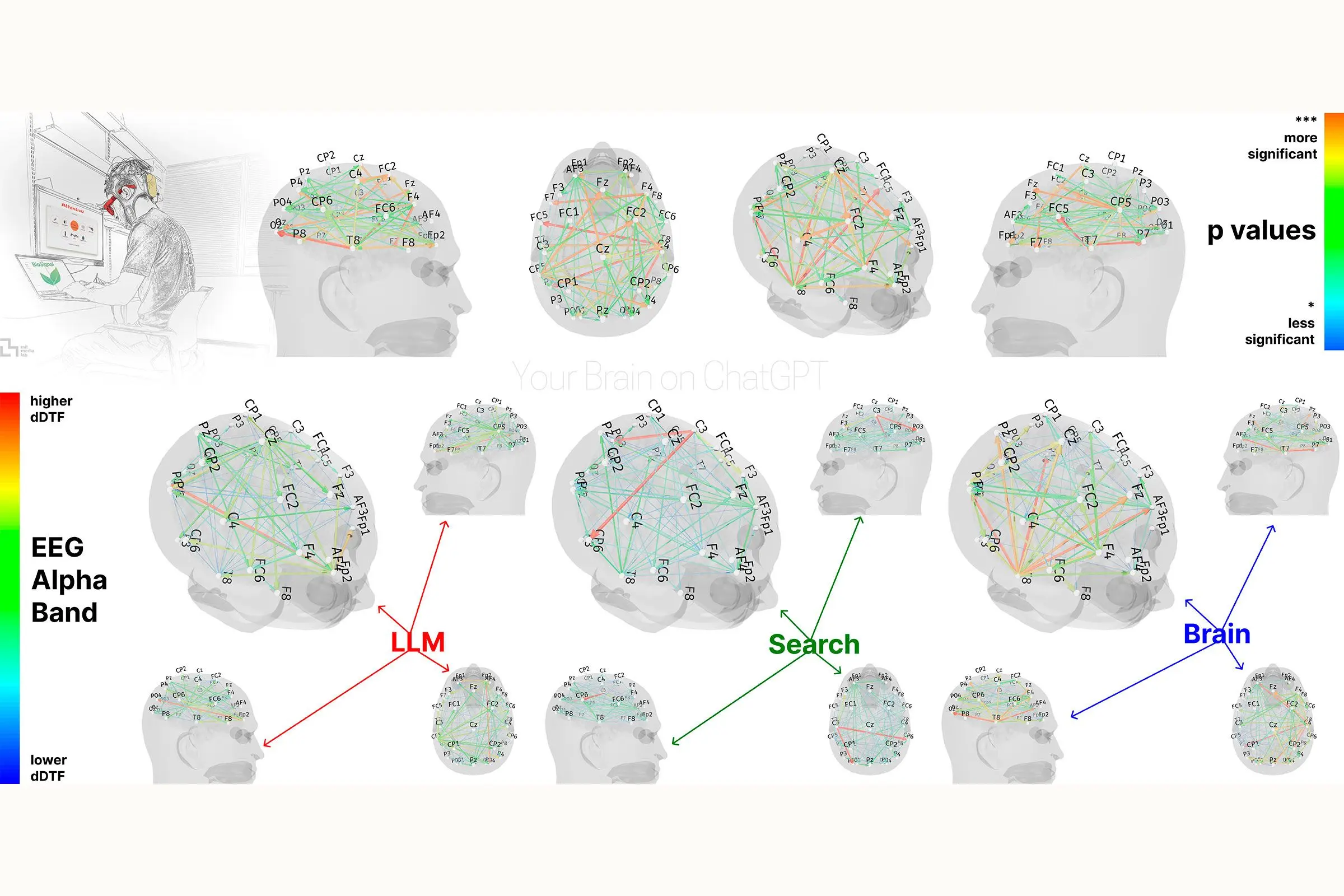
According to the technology industry, the future belongs to children who learn AI first.
I think they’re wrong.
Every generation of parents gets told that some new technology will transform education. AI is just this generation’s version. The pitch is always the same: it’s inevitable, kids need to learn it now, fall behind and you’re behind for good.
It’s persuasive because it targets every parent’s deepest fear – that their kid won’t be ready for the world they’re growing into. But before we accept that, it’s worth asking a more basic question:
what is AI actually teaching children, and what is it replacing?

Should Children use AI?
The research tells a messier story than the marketing. Across multiple studies, the same pattern keeps showing up: kids who lean on AI heavily retain less, think less critically, and stop questioning the answers in front of them. One study found students learned more when they wrestled with a problem first and used AI afterward but heavy reliance on AI from the start led to worse memory retention.
Researchers describe the broader phenomenon as cognitive offloading: the brain stops doing work the moment it can hand that work off to something else, and younger users show the steepest drop-off in critical thinking as a result. None of this should be surprising. Learning was never really about landing on the right answer, it’s about the mental effort it takes to get there.
Skip the effort, and you skip the learning, no matter how good the answer looks.
The Ipad Generation

This isn’t the first time tech promised to improve childhood. Smartphones, tablets, and social media all arrived with the same optimistic pitch — connection, creativity = better learning outcomes. Years later, parents and educators are still dealing with the fallout: shorter attention spans, screen dependence, kids who struggle to sit with boredom or delay gratification. None of that happened by accident.
The companies behind these products spent real money figuring out how human psychology works, then built infinite scroll, notifications, and recommendation algorithms specifically to exploit it. Engagement was the goal, not education. The longer a kid stayed on the platform, the more the product won. Now many of those same companies are asking parents to trust them again, this time with something even more intimate than attention: their children’s thinking.
The Gamification of Learning

The same playbook shows up inside the classroom itself. Education platforms lean hard on points, badges, streaks, and leaderboards because they’re genuinely good at generating a quick burst of excitement. The research is consistent on what happens next, though: that excitement fades fast once the novelty wears off, and studies on gamified learning find kids increasingly chasing the reward instead of understanding the material underneath it. Should learning be an intrinsic reward or extrinsic?
Real learning runs on something less flashy…curiosity, persistence, a willingness to sit with a hard problem instead of grabbing for the nearest answer. Those habits build slowly, usually through some amount of frustration, and no interface design can manufacture them. I love seeing this at Quantum, when kids learn to persist.
AI Replaces More Than Work
For adults, AI is a genuine productivity tool. For kids, productivity isn’t really the point. Childhood is when the brain is busy building the (Atomic) habits that stick for life. When AI writes the paragraph, generates the idea, or explains the problem before a kid has actually struggled with it, it’s not just saving time. It’s standing in for the exact mental process school is supposed to build — somewhat similar to how writing with a pen re-writes the pathways of the brain, whereas a computer does not.
A kid who asks an AI how to solve a coding problem will probably get a solid answer. What’s less clear is whether they’ve learned anything that helps with the next problem, especially the one AI gets confidently wrong. Knowledge matters. Knowing how to think still matters more — which as a quick aside, is why I believe philosophy should be taught at an early age!
Childhood Needs Friction

A lot of modern education treats frustration as something to engineer away. In practice, frustration is one of the best teachers a kid will ever have. The circuit that doesn’t work. The robot that won’t move. The code that throws an error nobody expected. Those aren’t obstacles in the way of learning – they’re where the learning actually happens. A kid pokes at the problem, makes a guess, watches it fail, adjusts, and eventually gets it working. That loop builds habits like resilience, analytical thinking, the confidence that comes from earning an answer. That carry well beyond robotics or code, and that no AI model can hand a child on its behalf.
So what kind of education actually builds those habits?
Learning at Quantum Makers Studio

Picture two kids building the same automatic night light. One asks an AI for the wiring diagram and copies it down. The other spends twenty minutes figuring out why the LED won’t turn on, traces the circuit wire by wire, finds the loose connection, and finally watches it light up. Both walk away with a working project. Only one walks away having built the habits that engineering, and most of life, actually requires.
That’s the thinking behind how we run things at Quantum Makers Studio. Our students aren’t handed LEGO or finished robots and told to play with them — they build the things themselves. Whether they’re designing a product, wiring an Arduino gadget, 3D-printing a mechanism, or programming a robot, the project is only the vehicle. We don’t grade on how fast something gets finished. We care about the thinking that happened to get there. The goal was never the night light. It was the kid who now knows how to find a loose connection on their own.
Sources
A False Narrative / cognitive offloading
- Akgun & Toker pretesting/retention study — Frontiers in Psychology, “The cognitive paradox of AI in education: between enhancement and erosion” (2025): https://www.frontiersin.org/journals/psychology/articles/10.3389/fpsyg.2025.1550621/full
- Ododo et al., AI and passive acceptance in vocational students — same Frontiers paper (PMC mirror): https://pmc.ncbi.nlm.nih.gov/articles/PMC12036037/
- Gerlich (2025), AI use and critical thinking decline — Societies, covered by PsyPost: https://www.psypost.org/ai-tools-may-weaken-critical-thinking-skills-by-encouraging-cognitive-offloading-study-suggests/, and the journal itself: https://www.mdpi.com/2075-4698/15/1/6
- AI dependence + cognitive fatigue, 580 Chinese university students — ScienceDirect: https://www.sciencedirect.com/science/article/pii/S0001691825010388
- Student reflection citing MIT “cognitive debt” research — EDUCAUSE Review: https://er.educause.edu/articles/2025/12/the-paradox-of-ai-assistance-better-results-worse-thinking
iPad Generation / attention economy
- Tristan Harris background and persuasive design — Wikipedia: https://en.wikipedia.org/wiki/Tristan_Harris, and Grokipedia: https://grokipedia.com/page/Tristan_Harris
- Harris on attention-as-product business model — Wikibooks: https://en.wikibooks.org/wiki/Professionalism/Tristan_Harris,_Time_Well_Spent,_and_Smartphones
- Screen time and child development meta-review (46 studies) — PMC: https://www.ncbi.nlm.nih.gov/pmc/articles/PMC12563978/
- Brain structure changes in young children with more screen exposure — Children and Screens: https://www.childrenandscreens.org/learn-explore/research/attention-media-use-and-children/
Social Media / insecurity
- Online social comparison as predictor of vulnerable usage patterns, longitudinal study of 400+ adolescents — PLOS ONE / PMC: https://www.ncbi.nlm.nih.gov/pmc/articles/PMC12176166/
- Depressed teens and feelings of rejection/insecurity after scrolling — JMIR: https://www.jmir.org/2025/1/e73098
- Przybylski (2013) on “perfectly groomed” online image and self-esteem — referenced via ResearchGate: https://www.researchgate.net/publication/384460872_Impact_of_Social_Media_Use_Social_Comparison_Self-Esteem_Among_Adolescents
- Adolescence as a vulnerable window for digital feedback loops — PMC: https://www.ncbi.nlm.nih.gov/pmc/articles/PMC12500540/
AI Replaces Intelligence
- Cognitive offloading going beyond calculators/search to replace higher-order reasoning — IEEE Computer Society: https://www.computer.org/publications/tech-news/trends/cognitive-offloading
Gamification of Learning
Novelty effect and motivation decline over time — PMC systematic review: https://pmc.ncbi.nlm.nih.gov/articles/PMC10448467/
Large positive short-term effect of gamification on motivation (41-study meta-analysis) — Frontiers in Psychology (2023): https://www.frontiersin.org/journals/psychology/articles/10.3389/fpsyg.2023.1253549/full
Gamification skewing toward extrinsic motivation — Wiley (2025): https://onlinelibrary.wiley.com/doi/10.1002/pits.70056
Leave a Reply